















8 Ways MBR Assists Your Utility in Emergency Response
When disaster strikes, wastewater operators have one job above all others: keep wastewater treatment running.
Whether it’s a hurricane, flood, fire, or extended power outage, the systems that sustain communities are often the first to be tested. And among all treatment technologies available, membrane bioreactors (MBRs) have proven uniquely resilient, helping utilities recover faster, maintain compliance longer, and protect the environment when stress is highest.
Across our projects—from post-hurricane rebuilds to mountain-road lockouts—one theme stands out: MBR systems give utilities more control when the rest of the grid loses it.
- Lower Solids Yield Means More Time on the Clock
In emergency scenarios, solids handling becomes a race against capacity. When roads close and hauling stops, digesters fill, clarifiers lose performance, and treatment efficiency drops.
Why MBRs help:
- MBRs operate at longer solids retention times (SRTs) and higher mixed liquor suspended solids (MLSS) concentrations—typically 8,000–12,000 mg/L versus 2,000–4,000 mg/L for conventional activated sludge (CAS).
- The result: less sludge produced per pound of BOD removed.
- In practice, this means twice as much time before digester or EQ tanks hit critical volume.
For isolated facilities—like resorts, rural utilities, or mountain communities—this buffer can prevent a manageable situation from escalating into an environmental emergency.
- Resilience Under Hydraulic Stress
Disasters don’t respect design flow.
Heavy rains, inflow and infiltration, or emergency tie-ins from nearby damaged systems can push flow far above normal operating conditions. Clarifiers in conventional plants can’t handle these surges—they lose settling capacity, and solids wash out.
How MBRs stay stable:
- No clarifiers: Membrane filtration performs solids separation, keeping effluent clarity independent of flow rate.
- Higher MLSS and longer SRTs: The biological community is robust enough to maintain treatment quality even during short-term dilution or shock loads.
- Hydraulic flexibility: MBRs can handle peak-to-average (P/A) ratios of 3:1 or higher with proper equalization.
In real-world events, like storm surges or post-fire runoff, MBR plants have stayed online while neighboring facilities went dark.
- Rapid Deployment and Modular Flexibility
In the aftermath of hurricanes or wildfires, speed matters.
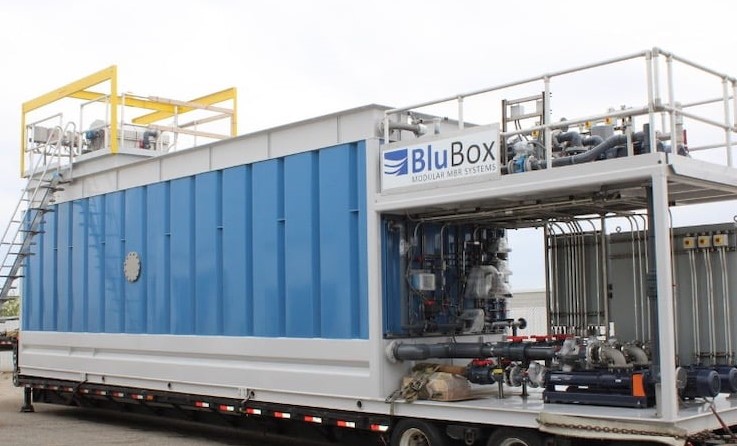
Traditional rebuilds require civil construction, permitting, and months of downtime. Modular membrane bioreactor technology—like the IWS BLU|BOX system—can be delivered, installed, and treating wastewater in a fraction of that time.
In practice, utilities see practical benefits:
- Skid-mounted and containerized: Units can be airlifted, trucked, or craned into tight sites.
- Plug-and-play design: Pre-integrated PLC controls and aeration reduce start-up time to days, not weeks.
- Scalable deployment: Operators can add or remove skids to meet emergency demand or bypass damaged process trains.
When IWS restored service at Spruce Pine, N.C., after Hurricane Helene, the MBR’s rapid mobilization got the town back in compliance faster than traditional reconstruction could even begin.
- Stable Effluent When Conditions Are Anything But
In an emergency, the most critical numbers on any operator’s screen are BOD and TSS.
When biological conditions shift or clarifiers flood, those parameters are the first to slip—and the first that regulators scrutinize after a disaster.
How MBRs protect compliance:
- Membrane filtration ensures solids separation even if biomass quality drops.
- Effluent remains clear and low in turbidity, often under 0.2 NTU—meeting reuse standards without polishing filters.
- Biological stability supports consistent BOD removal, keeping effluent below detection even when load strength fluctuates.
In sensitive receiving waters—like creeks, wetlands, or reclaimed irrigation—this stability can prevent long-term ecosystem damage.
- Automated Control and Power-Outage Preparedness
When grid power fails, every kilowatt-hour counts.
MBR systems give operators options:
- PLC-based automation keeps aeration, scouring, and recirculation under control even when on generator power.
- Load-shedding logic allows operators to disable non-critical equipment and prioritize key process loops.
- Remote SCADA control enables off-site monitoring when roads are blocked.
For utilities with limited staffing or backup power, automation reduces both risk and labor burden—ensuring treatment continuity even under constrained conditions.
- Compact, Enclosed Design for Structural Resilience
Open clarifiers and lagoons are easy targets for flood debris, wind, or contamination.
MBRs offer physical resilience through design:
- Enclosed basins and covered tanks protect active biology from intrusion.
- Buried or semi-buried installation provides insulation, structural protection, and freeze resistance.
- Smaller footprint systems are easier to flood-proof or elevate above high-water lines.
This compact resilience means MBRs can ride out storms that would cripple open-basin systems.
- Reuse-Ready Effluent for Emergency Water Supply
After disasters, water reuse becomes more than sustainability—it becomes survival.
MBRs produce reuse-quality effluent by default, often achieving Title 22 standards without tertiary filtration. That opens doors for:
- Dust control and construction cleanup during disaster recovery.
- Irrigation or landscape watering when potable water systems are down.
- Cooling water and process reuse for nearby critical facilities.
Utilities equipped with MBRs can pivot from treatment to resource supply within hours—helping the broader community recover faster.
- Built for Continuity, Designed for Recovery
Every emergency project that we provide MBR solutions for ultimately tells the same story:
- Less biosolids, fewer trucks.
- Faster recovery, smaller footprint.
- More automation, less chaos.
Whether you’re planning a new plant or hardening an existing one, membrane bioreactor systems provide a measurable safety net—one that keeps utilities in compliance, protects communities, and gives operators the breathing room they need when it matters most.
FAQs
What is a membrane bioreactor and how does it work in wastewater treatment?
A membrane bioreactor (MBR) is a wastewater treatment technology that combines a biological process with membrane filtration. In this system, microorganisms break down organic matter and nutrients, while a membrane module separates suspended solids, resulting in clear, high-quality effluent. This eliminates the need for a secondary clarifier and makes it highly effective during emergency situations when conventional treatment can fail.
How is an MBR system different from conventional activated sludge treatment?
An MBR system operates at higher solids concentrations and uses membrane separation processes instead of gravity settling. Unlike traditional activated sludge systems, MBRs maintain higher biomass concentration, which improves treatment efficiency and reduces sludge production. The use of a membrane surface ensures stable effluent quality even during high concentration loading or hydraulic stress.
Can membrane bioreactors handle peak flow during disasters?
Yes. MBRs—especially submerged MBR and immersed membrane bioreactor systems—are designed to handle peak-to-average flow ratios of 3:1 or more. Since membrane filtration replaces clarifiers, effluent quality remains consistent regardless of flow fluctuations. This resilience makes MBR technology ideal for hurricane recovery, flooding events, and other emergency response scenarios.
What types of membranes are used in MBR technology?
Most membrane bioreactor technology uses microfiltration or ultrafiltration membranes. Common configurations include tubular membranes and flat-sheet or hollow-fiber designs. These membranes have small pore sizes that prevent pore blocking and cake layer formation, ensuring consistent flux and long membrane life. Choosing the right membrane material can enhance durability and reduce fouling.
Can an MBR system be deployed quickly in an emergency?
Absolutely. Modular MBR systems are engineered for rapid deployment. Containerized units can be transported, installed, and operational in days. Because they don’t require large clarifiers or extensive civil work, utilities can restore municipal wastewater treatment faster than with conventional systems. This makes MBRs a proven solution for disaster recovery and emergency bypass treatment.
How does MBR technology support water reuse?
MBRs produce reuse-quality effluent suitable for tertiary applications like irrigation, construction cleanup, and cooling water. The membrane process removes colloidal particles, soluble microbial products, and suspended solids, often meeting Title 22 standards without additional polishing. This allows utilities to turn treated municipal wastewater into a valuable resource during emergencies.
How do MBR systems help with nutrient removal?
MBR systems support advanced nutrient removal, including nitrification, denitrification, and phosphorus reduction. The activated sludge process combined with membrane separation maintains stable biological conditions, enabling effective removal of nitrogen and other nutrients even during variable loads. This is especially beneficial for sensitive receiving waters.
Are membrane bioreactors reliable during power outages?
Yes. MBR plants are often equipped with PLC automation, SCADA monitoring, and load-shedding capabilities. This allows critical membrane process components to keep running on backup power. With aeration and recirculation controlled remotely, operators can maintain treatment performance during blackouts or limited access periods.
Is MBR technology suitable for both small and large municipal utilities?
Yes. MBR technology is scalable and can be configured for both small, rural systems and large municipal wastewater facilities. Thanks to flexible configurations, utilities can add or remove membrane modules to meet changing flow and load conditions. Its compact footprint makes it especially suitable for land-constrained sites or high concentration treatment needs.