


















Designing for Growth: How to Build Modular Capacity Without Breaking Ground Twice
There’s a quiet kind of pressure that builds behind every new development, every expanding utility, every industrial upgrade. It’s the pressure of what comes next in your wastewater treatment system and overall water treatment strategy.
You can size a wastewater treatment plant for today’s needs, but what about tomorrow’s influx of tenants? Next year’s new product line? The future rezoning that triples occupancy and sends more domestic wastewater and raw sewage into the sewer system?
Most systems are built with a shovel and a spreadsheet. Few are built with foresight.
And that’s where modular MBR design becomes a strategy.
The High Cost of Short-Term Thinking
Every utility has a story. One organization might underestimate growth and then retrofit their wastewater treatment facility within 24 months of commissioning. Another might build for an optimistic future and sit on idle capacity for years. Neither approach is wrong, per se, but both cost more than they should have.
What if we could sidestep the trap entirely?
Membrane bioreactor (MBR) systems give us that option. Their compact design and process flexibility make it possible to build in phases, expand in place, and respond in real time to actual growth—not projections on a slide deck. With the right modular wastewater treatment system, utilities can protect water quality, safeguard public works, and consistently produce treated wastewater that supports clean water goals.
The goal is simple resilience. A plant that grows with you is a plant that protects you from surprise demand, from regulatory headaches tied to standards like the Clean Water Act, and from the bruising cost of tearing up what you just built.
What Modular MBR Design Looks Like in Practice
The first rule of modularity is simple but non-negotiable: plan early.
The moment concrete is poured, flexibility starts to vanish. And in wastewater treatment, inflexibility is expensive.
At IWS, we approach every project with an architectural mindset: designing systems not just for day-one performance, but for long-term adaptability. That means future expansion is a design path already built into the blueprint of the wastewater treatment plant and related water treatment facility assets.
Plan the Skeleton for Full Build-Out
We size key infrastructure—like process buildings, blower systems, electrical panels, and effluent lines—with the end-state in mind. Even when the initial capacity is modest, we ensure the backbone of the facility can carry the weight of its future self.
We ask: If this system triples in capacity, will the wiring hold? Will the structure accommodate added equipment? Will the controls scale without rewiring the entire logic?
These aren’t hypotheticals. They’re standard design prompts. By answering them upfront, we allow utilities to scale without rework.
Map the Future Into the Site Plan
Modular design is a spatial consideration at its heart. It’s about leaving room for the next train. Mapping out stub-outs, pipe galleries, and membrane basins ensures that expansion isn’t disruptive. It’s pre-staged.
IWS designs include clearly marked tie-in points, additional pad space, and utility chases to reduce the time and cost of future construction. This forethought can shave weeks off an expansion schedule and spare the facility from unnecessary downtime.
Standardize for Speed
One of the most effective ways to make modularity seamless is to standardize the building blocks.
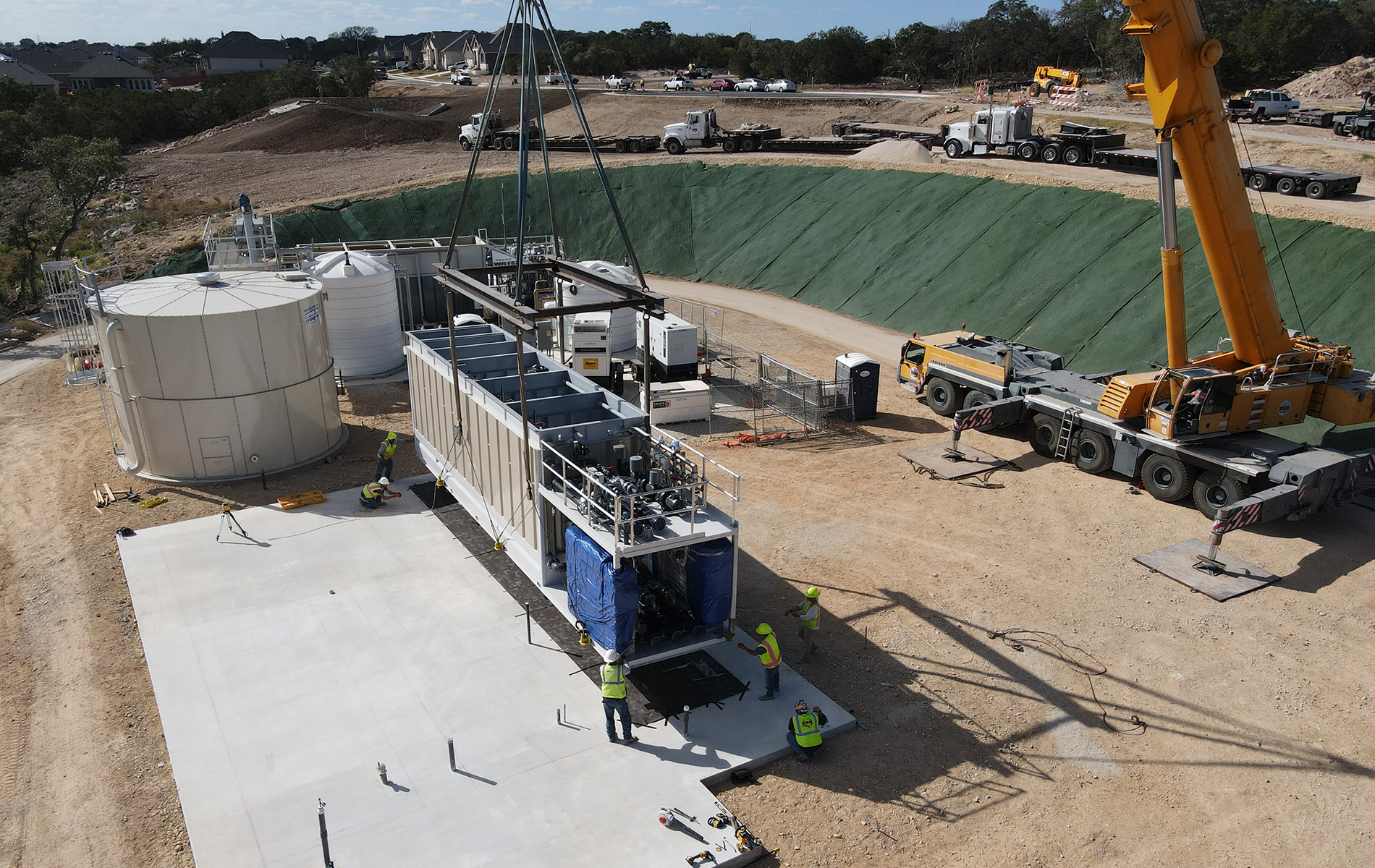
That’s why we frequently use prepackaged or skid-mounted MBR units: they arrive to your site fully assembled, factory tested, and ready to install. This not only ensures quality and speed but allows the expansion process to follow a predictable playbook.
Once the groundwork is laid, additional units can be dropped in, connected, and brought online in days—not months. No new permits. No new surprises. Just system growth that behaves like it was meant to happen.
Think in Units, Not in Retrofits
We don’t wait until a facility is overburdened before considering expansion. We design in terms of units, with each one a discrete unit with its own membranes, blowers, and controls, designed to integrate cleanly into the larger system.
This approach aligns perfectly with phased development and rolling buildouts. Whether it’s a growing subdivision, a seasonal resort, or a commercial utility serving new tenants, each new phase can be met with an equally modular capacity increase.
Designing for the Unknown
Modular systems can handle more flow, yes, but they’re also about changing needs over time.
Maybe your tenant mix shifts from office to restaurant and organic matter and wastewater solids increase. Maybe your industrial process changes and nutrient concentrations spike. Maybe your regulatory limits tighten after a review from the Environmental Protection Agency. If your plant was built to accommodate only one scenario, you’re stuck.
But if it was built to evolve—if the core infrastructure is elastic, if the controls are scalable, if the process units are additive—then adaptation is a feature, not a scramble.
And that’s the promise of modular MBRs: not just to treat wastewater efficiently, but to treat change as expected. It turns a single wastewater treatment facility into a flexible, long-term treatment plant platform.
Break Ground Once. Build for the Long Haul.
At IWS, we believe wastewater systems should never be static monuments. They should breathe with the communities they serve. They should make room for the future.
Whether you’re a developer planning in phases, a private utility facing surging demand, or an engineer who simply doesn’t want to break ground twice—let’s talk about building for growth without rework.
Let’s build the system you’ll need tomorrow, today.
FAQ
1. What is a modular MBR wastewater treatment plant?
A modular membrane bioreactor (MBR) wastewater treatment plant is a compact wastewater treatment system built from repeatable process units instead of one oversized basin. Each module combines activated sludge biology with membrane filtration to produce treated wastewater and treated water with excellent water quality. Because the plant is modular, you can add capacity in phases as incoming wastewater and sewage flows grow, rather than breaking ground for a new treatment plant every time demand changes.
2. How is a modular MBR system different from a conventional sewage treatment plant?
A conventional sewage treatment plant or sewage treatment plants typically rely on large aeration tanks, sedimentation tanks, and other fixed structures sized for a long-term design flow. A modular MBR wastewater treatment facility uses smaller, standardized units—often skid-mounted—that integrate aeration basins, membranes, and controls into compact packages. Instead of retrofitting concrete tanks, you expand by adding more units to the existing treatment facility, keeping water quality and clean water goals on track while minimizing disruption.
3. Can modular MBR plants handle both municipal wastewater and industrial wastewater?
Yes. Modular MBR wastewater treatment plants can be designed for municipal wastewater, domestic wastewater, and many types of industrial wastewater. The biological process and membrane configuration can be tuned to manage higher loads of organic matter, organic solids, and wastewater solids that often come from industrial users. As flows and loads change, utilities can add more modules, adjust aeration, or incorporate additional sludge treatment and digesters to keep performance aligned with permit limits and real-world conditions.
4. How does modular design support long-term Clean Water Act and EPA compliance?
Modular systems make it easier to stay ahead of tightening regulations under the Clean Water Act and evolving Environmental Protection Agency expectations. When discharge limits change, utilities can add process units for additional polishing, increase sludge treatment and biosolids handling, or upgrade controls within the existing wastewater treatment plant footprint. Instead of a one-time build that becomes outdated, modular wastewater and sewage treatment plants are designed to evolve with new standards for water quality and environmental services.
5. What core infrastructure should be planned for full build-out of a modular treatment plant?
For a flexible wastewater treatment plant or water treatment facility, the “skeleton” matters as much as the modules. IWS designs projects so that process buildings, sewer system connections, electrical gear, control panels, and piping can support the ultimate build-out. That may include space for more aeration basins, anaerobic digester units, anaerobic digestion equipment, or additional membrane trains. By planning these loads up front, the treatment plant can move from a small starter system to a full-scale municipal wastewater treatment facility without re-pouring concrete.
6. How do modular MBR systems handle sludge treatment, biosolids, and digesters?
As flows and loading increase, so does the need for reliable sludge treatment and biosolids management. A modular MBR treatment facility can include phased installation of thickening equipment, digesters, or an anaerobic digester system to stabilize solids. This approach supports more efficient handling of organic solids, reduces hauling costs, and creates a predictable path for expanding solids handling without shutting down the wastewater treatment plants already in service.
7. What role do microorganisms play in a modular wastewater treatment system?
In every biological wastewater treatment process, microorganisms are the engine that removes pollutants. In modular MBR and activated sludge systems, carefully managed microbial communities break down organic matter in raw sewage and incoming wastewater. The modular approach ensures that as flows rise, new units can be added with their own optimized biomass, aeration, and control, keeping performance stable and protecting water resources and drinking water supplies downstream.
8. Can modular MBR design work with existing sewer and water infrastructure?
Yes. Modular design is often integrated into existing sewer system and water treatment assets. IWS plans stub-outs, tie-in points, and future pad locations so additional MBR units, sequencing batch reactor upgrades, or polishing steps for recycled water can be added later. This allows utilities and public works departments to turn a single plant into a long-term platform that supports clean water, water treatment plants, and broader environmental services without relocating or rebuilding.
9. When should a utility start planning for modular expansion?
Planning should begin before the first yard of concrete is poured. The earlier a utility considers modular expansion, the easier it is to size electrical gear, controls, and civil works for future units. Whether you’re building a new wastewater treatment system or upgrading an existing wastewater treatment plant, IWS helps map out a phased plan so you can start with what you need now—and have a clear, low-friction path to the wastewater treatment facility you’ll need as demand grows.