
















From the Field to the Future: How a Central Texas Project Gave Rise to the NXT|MBR™ Platform
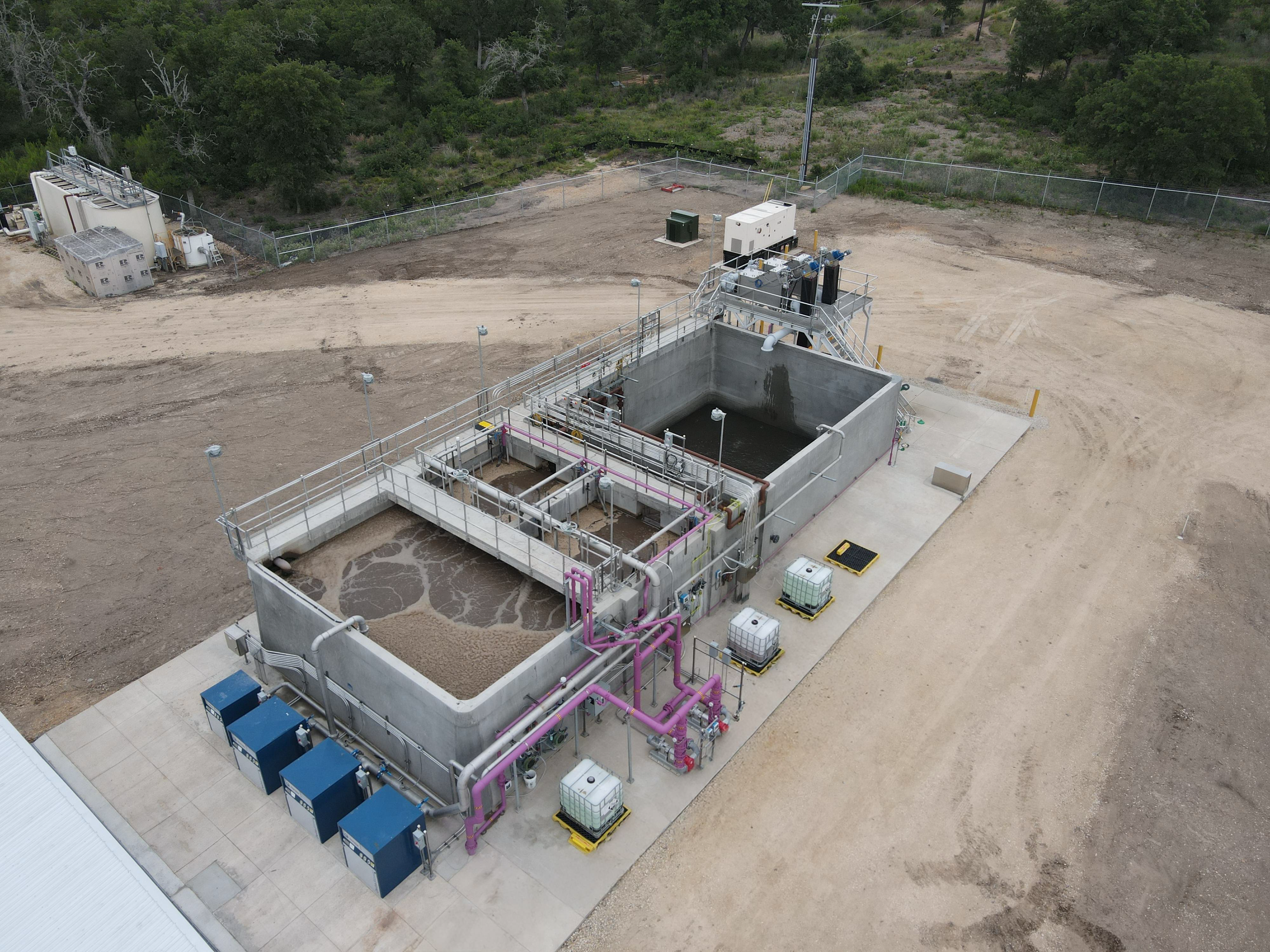
Not every platform begins in a boardroom. NXT|MBR™, the integrated membrane bioreactor system developed through a formal collaboration between Integrated Water Services (IWS) and CROM, traces its origins to a specific set of engineering constraints on the outskirts of Austin, Texas.
The McKinney Roughs Nature Park wastewater treatment facility was aging, undersized, and operating under some of the most demanding discharge requirements in the region. With new residential development and a school on the horizon, the plant’s owner and operator, Corix Utilities (now Nexus Water), needed to triple capacity, from 0.25 MGD to 0.75 MGD, while maintaining strict effluent limits tied to direct discharge into the Lower Colorado River, a protected source of downstream drinking water and aquifer recharge.
Initial planning centered on conventional activated sludge. When cost projections were refined, the numbers moved beyond the available capital range. That constraint forced a harder look at alternatives, and ultimately led to a technology integration that neither team had formally packaged before.
The Engineering Decision at the Core of This Project
IWS and CROM evaluated a configuration that paired a membrane bioreactor (MBR) treatment process with CROM’s watertight tensioned shotcrete containment system, the CROM2 tank, as an alternative to traditional concrete construction. It was the first time an MBR system had been deployed within CROM’s structural platform.
The revised approach reduced footprint requirements, simplified solids separation, and brought the project back within budget without compromising on performance. IWS managed the project from permitting and engineering through construction and startup of the initial 0.25 MGD expansion phase.
The treatment train included the following zones:
- EQ Zone — Equalization basin for hydraulic buffering and flow attenuation
- Anoxic Zone — Biological denitrification for total nitrogen reduction
- MBR Zone — Membrane-based solids separation delivering high-clarity effluent
- Aerated Zone — Nitrification and aerobic stabilization
- CROM2 Tank — Watertight, tensioned shotcrete structural vessel housing the entire treatment system
The project was completed ahead of schedule and under budget.
Effluent quality consistently met all permit limits. Corix’s satisfaction with the outcome led directly to repeat business, and to a broader question about whether this integrated approach could be standardized and deployed at scale.
What Made This Different from a Conventional MBR Project
MBR technology itself is not new. What distinguished the McKinney Roughs installation, and what ultimately formed the basis of NXT|MBR, was the deliberate integration of the treatment process and structural vessel within a single, coordinated delivery framework.
In most decentralized wastewater projects, the process engineer, structural designer, contractor, controls integrator, and startup team operate under separate scopes. This fragmented delivery model can produce technically sound outcomes, but it creates accountability gaps that often surface after commissioning, particularly in smaller facilities with limited operations staff.
At McKinney Roughs, those responsibilities were aligned within a single team from the outset. Process design decisions reflected the structural system’s geometry. Commissioning was planned in coordination with construction. The owner received a single point of accountability from concept through startup.
That delivery model became one of the defining characteristics of the NXT|MBR platform.
Introducing NXT|MBR: Decentralized Treatment as a Permanent Asset
Building on the McKinney Roughs project, IWS and CROM formally developed the NXT|MBR platform, a standardized, scalable decentralized treatment system designed for long-term infrastructure service.
The platform combines two mature technologies in a purpose-built configuration:
MBR Process Performance. Membrane bioreactor treatment provides stable biological performance and membrane-based solids separation in a compact footprint. The process consistently delivers low turbidity, strong nutrient removal, and effluent quality suitable for non-potable reuse applications including irrigation and industrial cooling. For commercial and residential developers, private utilities, and municipalities managing water scarcity or reuse mandates, treated effluent from an NXT|MBR facility is a recoverable resource, not a disposal problem.
CROM Structural Durability. The CROM straight-wall watertight tensioned shotcrete containment system is designed and constructed to ACI-350 water-retaining structure standards. It incorporates an embedded steel diaphragm and tension enhancement engineered for long-term watertightness and corrosion resistance in continuous wastewater service. Where standard concrete structures develop leaks and cracks, CROM’s system is engineered to eliminate those failure modes. The structural platform is designed for a 50-plus-year service life, aligning with the long-term investment horizons of both public utilities and private infrastructure owners.
Together, the two systems form a facility architecture that supports phased capacity expansion in 250,000-gallon increments, predictable commissioning, remote monitoring, and multi-decade operational stability.
Why This Matters for Engineers and Operators
For technical practitioners evaluating decentralized treatment options, NXT|MBR addresses a set of recurring challenges that conventional approaches often fail to resolve cleanly.
Structural lifecycle cost. Degrading tanks introduce recurring repair cycles that persist for decades. In facilities with limited staffing and tight operating margins, structural maintenance competes directly with process attention. A containment system engineered for permanence removes that burden from the operational baseline. When the vessel remains stable, operators focus on treatment — not tank remediation.
Effluent quality and reuse readiness. MBR-based separation consistently outperforms secondary clarification on turbidity and suspended solids, producing effluent suitable for Title 22 or equivalent reuse standards in most jurisdictions. For facilities near sensitive water bodies, like the Lower Colorado River, or in regions where reuse is a planning requirement, this performance profile is often necessary, not optional.
Modular expansion without site disruption. The NXT|MBR platform is structured around repeatable 250,000-gallon capacity increments. Owners can deploy capital in stages aligned with actual growth rather than building to peak capacity upfront. The standardized structural geometry simplifies future expansion coordination and preserves site coherence over time.
Integrated delivery and reduced coordination risk. Process engineering, structural construction, mechanical and electrical integration, startup, and long-term support are coordinated within a single delivery framework. For operators who have experienced the commissioning delays and post-construction troubleshooting that often accompany fragmented project delivery, this alignment represents a meaningful reduction in project risk.
Remote monitoring and automation. Instrumentation provides continuous visibility into flow conditions, dissolved oxygen, membrane flux, and key process indicators. Control systems support stable operation under variable loading. Remote access capabilities allow operators to manage multiple sites efficiently, a practical necessity for private utility portfolios and distributed municipal systems alike.
Application Context
NXT|MBR is best suited for decentralized scenarios where long-term service life, reuse readiness, and phased expansion capacity are primary planning priorities. Deployment contexts include:
- Private utilities expanding community system portfolios, where modular growth and vertically integrated delivery reduce portfolio management complexity
- Municipal utilities managing growth through satellite or independent treatment facilities, where compact footprint and reuse-ready effluent support both compliance and resource recovery objectives
- Industrial facilities requiring pre-treatment of complex waste streams or internal process water reuse, where structural durability and operational stability are baseline requirements
- Commercial and real estate developments where on-site treatment is required and footprint, odor, and aesthetics are critical constraints
From McKinney Roughs to a Replicable Platform
The McKinney Roughs facility demonstrated something that cost models and feasibility studies rarely capture cleanly: when structural durability and treatment process are designed together, the result is a facility that performs more predictably, costs less to sustain, and retains long-term value for the owner.
That outcome—one project, completed on time and under budget, producing permit-compliant effluent, with a satisfied repeat client—provided the practical foundation for formalizing NXT|MBR into a defined, repeatable platform. The CROM2 tank at McKinney Roughs was not a prototype. It was a proof of concept that already performed.
IWS and CROM are now applying that framework to a defined set of flow configurations designed for repeatable deployment across the decentralized wastewater market in the United States. The guiding premise is straightforward: while traditional modular systems provide unmatched rapid-deployment flexibility for evolving site needs, NXT|MBR’s concrete framework offers a fixed, century-class foundation for projects requiring maximum structural permanence.
Learn More
Integrated Water Services provides scalable and modular process and wastewater systems, along with engineering, design-build, permitting, and startup services across the municipal, industrial, and commercial sectors.
To discuss how the NXT|MBR platform aligns with your project requirements, contact IWS at integratedwaterservices.com.