
















How Portable Membrane Technology Performs Under Pressure in Emergencies
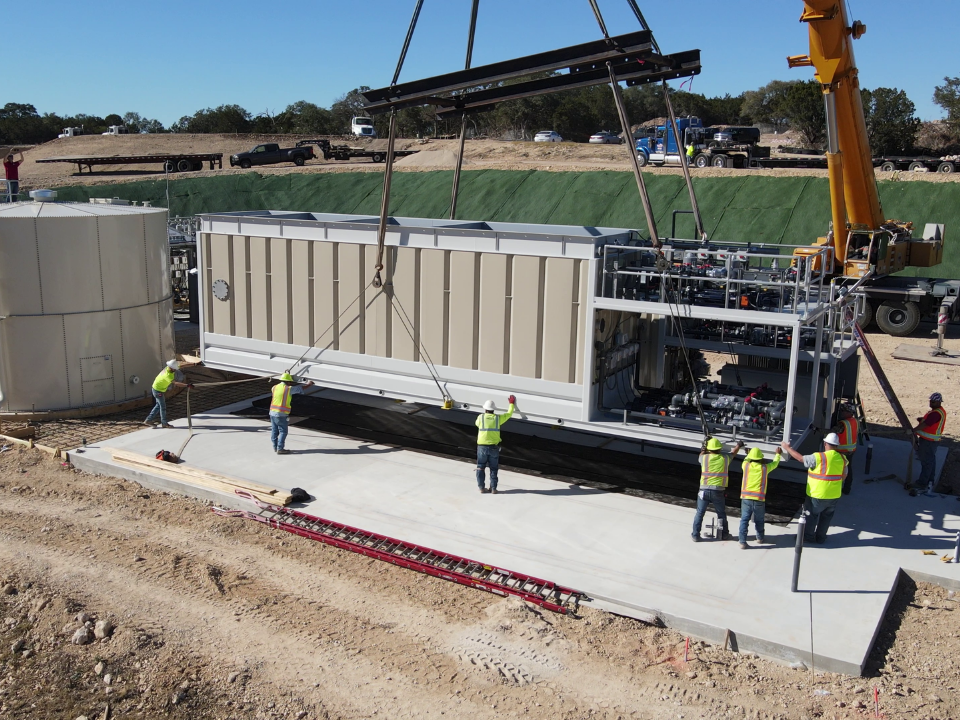
When a treatment system goes down, whether from a hurricane, a flood, an equipment failure, or a regulatory action, the question quickly turns to what technology can be on-site, producing compliant effluent and solving an urgent problem.
That’s a different engineering problem than the one most people are trained to solve. Consider capital planning, long-lead procurement, multi-year permitting: None of that applies when a plant manager is staring at a consent order deadline or a public works director is trying to restore basic services to a flooded community.
In those moments, the evaluation criteria compress down to a handful of things that actually matter: How fast can it be here? How quickly can it be operational? And will it reliably produce effluent that satisfies the permit?
Membrane bioreactor (MBR) technology answers all three questions extremely well. Here’s why.
What Makes MBR Different in an Emergency
A conventional activated sludge system relies on gravity to settle solids out of treated water in a secondary clarifier. That’s a process that works reasonably well under steady-state conditions, such as controlled flow, stable biomass, predictable loading. But emergency scenarios are defined by the absence of those conditions. Surge flows, disrupted microbiology, compromised infrastructure: these are exactly the conditions under which a clarifier-dependent system struggles.
MBR replaces the clarifier with a physical membrane barrier, typically hollow fiber or flat sheet configuration, through which permeate is drawn under negative pressure. The membrane doesn’t rely on settling time, gravity, or hydraulic quiescence. It filters.
This means that even when flow rates are variable, even when influent loading is unpredictable, and even when the biological community is still establishing itself after a startup or restart, the effluent leaving the system has passed through a membrane with pore sizes in the microfiltration or ultrafiltration range. Turbidity, TSS, and most pathogens are removed by physical exclusion, not by process conditions being perfect.
That’s a meaningful performance guarantee when conditions are anything but perfect.
Effluent Quality That Holds Under Stress
In a crisis, effluent quality is often the primary concern. Discharge permit violations during an emergency don’t pause enforcement. Industrial facilities still face fines. Municipal systems still have downstream obligations.
The entire point of a rapid-deployment treatment system is to maintain compliance while the permanent solution is designed, procured, and installed–or in many cases simply repaired to optimal condition.
MBR effluent consistently achieves low BOD and TSS concentrations, typically well below 10 mg/L for each, along with turbidity levels in the range of 0.1 to 0.3 NTU. These are not best-case numbers; they reflect routine MBR performance across a wide range of applications and operating conditions. The membrane provides a physical floor on effluent quality that a clarifier-based system simply cannot replicate, particularly under hydraulic stress.
For facilities with nutrient limits, MBR’s ability to operate at high mixed liquor suspended solids concentrations, supports effective nitrification and, with appropriate anoxic zone configuration, denitrification as well.
A well-configured packaged MBR system meets basic effluent standards, and can achieve biological nutrient removal at the same time.
Deployment Geometry: Why Compact Matters
Emergency response is a logistics problem as much as an engineering one. Systems have to get to the site. They have to fit where the site allows. They have to connect to existing infrastructure without a months-long civil works program.
This is where MBR’s compact footprint becomes operationally decisive. Because MBRs operate at high biomass concentrations, the aeration basin volume required to achieve a given treatment capacity is substantially smaller than a conventional system designed for the same flow. Skid-mounted and containerized MBR systems take that compact process and package it for transport; the civil interface is minimal by design.
For sites where space is genuinely constrained, such as a damaged plant in the middle of a developed municipal area, a tight construction staging zone, or a disaster-struck town where mud and debris have choked out usable land, compact geometry is everything. In an emergency or rapid-response scenario, a system’s footprint is often the sole variable determining whether a solution can actually be deployed on day one, or if it simply looks good on paper.
Startup and Stabilization
A common concern with deploying biological treatment in emergency contexts is the seeding period, the critical window required for a microbial community to establish, before the biomass can reliably treat wastewater to permit limits. In rapid-response scenarios, this startup lag is a legitimate regulatory risk..
However, containerized MBR systems fundamentally change this timeline. By seeding the system with mixed liquor from an operating facility, the startup phase is drastically compressed., Because the ultrafiltration membrane acts as an absolute physical barrier independent of biological maturity, the system can begin producing compliant, low-turbidity permeate from day one.
While the biological community takes a few days to acclimate and optimize nutrient removal, the membrane prevents biomass washout and provides reliable compliance baseline immediately. For facilities managing a six- to 12-month bridging period, such as an emergency plant rebuild or an extended compliance schedule, this immediate stabilization eliminates the early-stage regulatory risk that shadows conventional system startups.
The Bridge to Permanence
The most important thing to understand about emergency MBR deployment is what it’s actually doing from a strategic standpoint. It’s buying time—clean, compliant, defensible time—for the permanent solution to be properly engineered and built.
That’s not a compromise. That’s the right way to approach infrastructure continuity. Rushing a permanent design decision under crisis pressure produces worse outcomes than stabilizing operations, restoring compliance, and then executing a deliberate capital project with the time to get it right.
A well-deployed portable MBR system does exactly that. It holds the regulatory line. It keeps operations running. And it gives engineers, utilities, and operators the one resource that an emergency takes away: time to think clearly about what comes next.