
Unique Opportunity for Youth - Sustainable Wastewater Solutions
LOCATION: San Jose, CA
SERVICES: Construction; Start-up/Operations
TECHNOLOGY: Constructed Wetlands
SUSTAINABLE / WATER REUSE: Sustainable Media / Natural Treatment
Since its establishment in 1936, YMCA Camp Campbell (Camp) has served tens of thousands of kids, from all over the greater San Jose, CA area, and provided them with the opportunity to learn about positive values essential for future success. The existing wastewater system did not include treatment beyond septic tanks and needed to be upgraded to meet Santa Cruz County requirements. The Camp is in the process of developing and constructing new facilities providing further impetus for the Camp to upgrade the wastewater system. Keeping with the Camp’s mission, they chose a wastewater treatment process that would enhance the campus and provide the opportunity to teach campers about ecology, sustainability and responsible wastewater management.
Living Machine System
After researching their options, the Camp decided to install a Living Machine® system, a proprietary technology provided by Worrell Water Technologies (WWT). IWS was selected to install and start up the system. These are decentralized wastewater treatment systems that mimic processes found in wetland environments. The WWT patented technology uses mechanical and computer systems to enhance natural biological processes to treat wastewater. Living Machine systems provide a natural approach to wastewater treatment for communities, industries, academic institutions and government agencies. Using less energy than many other onsite wastewater treatment systems, Living Machine systems provide tertiary treatment, allowing the water to be reused for numerous applications including irrigation, toilet flushing, and wash water. Living Machine systems are frequently integrated into larger water reuse systems to increase water conservation, minimize wastewater surcharges, and meet operational requirements.
Design-Build Team
IWS partnered with Worrell to complete the Design-Build of the Tidal Wetland Living Machine® System at the Camp. This project follows a previous successful design-build effort between IWS and WWT at the Esalen Institute (Esalen) located in Big Sur, CA in January of 2008.
System Design
Camp Campbell’s Architect, Aron Faegre (Arron Fagre & Associates – Portland, Oregon) and the Camp’s senior management wanted a green alternative that would treat the wastewater, serve as classroom, and provide “teaching opportunities” for the campers. A new, shallow effluent dispersal system was designed by Andrew Brownstone of Biosphere Consulting (Santa Cruz, CA). Biosphere’s local knowledge and experience was an important element in getting the permits and in designing a dispersal system that would be effective in distributing the treated effluent in a heavily wooded area with shallow suitable soils.
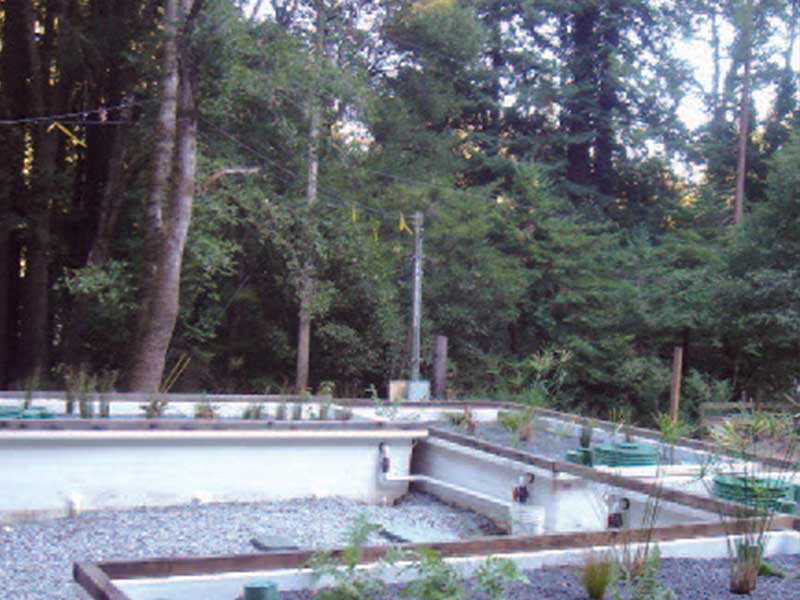
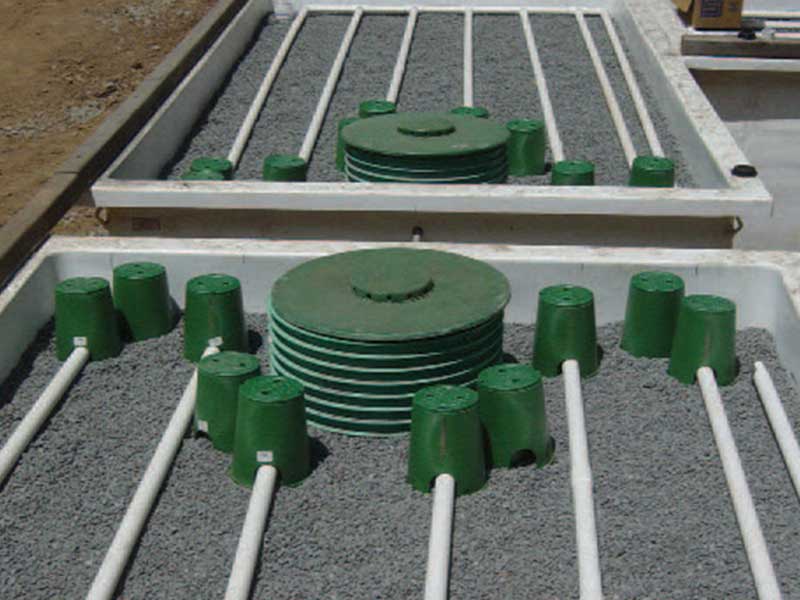
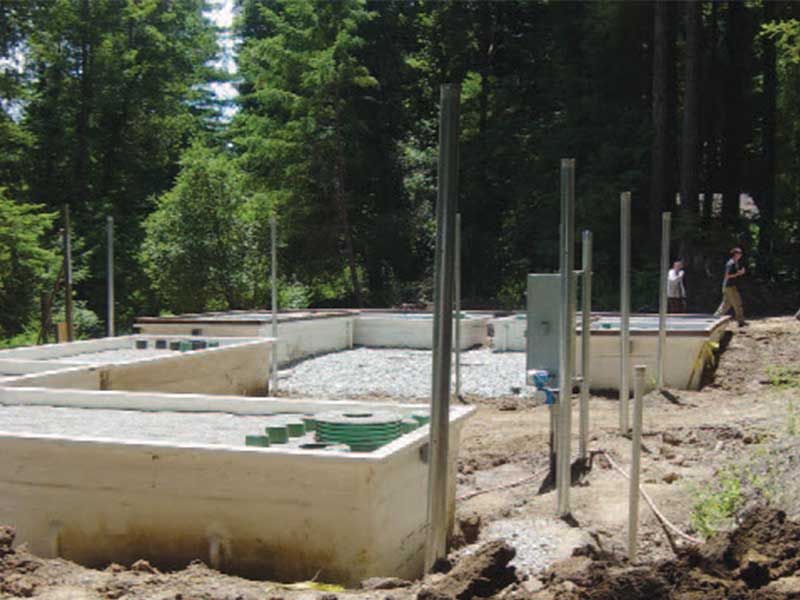
The Tidal Wetland Living Machine system was constructed in a clearing on the north end of the campus near the new dispersal field. System design highlights are summarized below:
- Design flow was 4,000 gallons per day average flow of high strength wastewater.
- The recirculating Tidal Wetland technology can accommodate the high strength wastewater generated by the camp with the wide fluctuation in flow and loading that occurs.
- The two-stage engineered wetland is designed to produce high quality effluent that is required for the new dispersal system, while requiring a minimum of operator input.
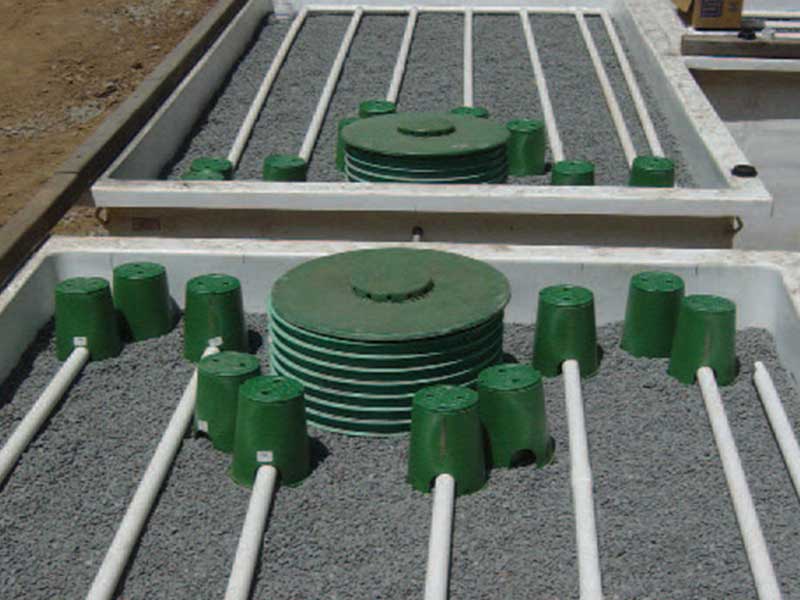
- The wetland cells consist of seven fiberglass tubs set partially in the ground and filled with a special engineered media resting on an under drain system. Cell surfaces are planted with native wetland type plants.
- The design uses minimal energy for the level of treatment provided.
- The second stage cells and control panel will be enclosed in a green-house to provide year round classroom space and operator access and workspace.
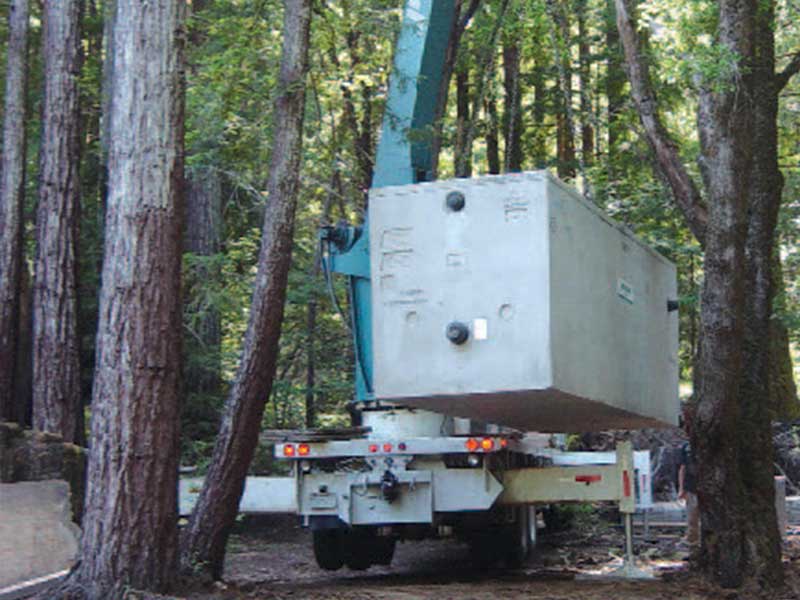
- The system includes buried recirculation tanks and an effluent pump tank.
- A Shallow Pressurized Dispersal System (SPDS) was used for the treated effluent. It was constructed in 2 cells, with a total of 8 zones. Each zone has four, 60 ft long shallow pressurized channels covered by a 12 inch diameter half pipe. The SPDS totaled nearly 2,000 linear feet buried 10 to 12 inches below the surface.
- A micro-computer based control system with a touchscreen user interface automates monitors all treatrment process and disposal.
- Internet communication with the controls system provides allows for automated alerts, performance monitoring and remote control access for operators.
Project Challenges
The camp is situated amidst the steep slopes and wooded hills of Boulder Creek, CA, where average rainfall is more than 45 inches per year. The towering redwoods and nearby stream make it a wonderful setting for a camp that focuses on outdoor experiences and learning. IWS worked with the Owner, Architect, and Engineer to address constructability and installation issues early in the process which added value to the design process and overall project. David Fisch, VP of Property for the YMCA of the Silicon Valley, said of the process, “The IWS team was a real asset during the design and project planning phase, as we addressed issues early on which made for a better project. They really added value to the process”.
For more information, please click the ‘Contact’ tab to reach out to us.