
















Why Square Is Better Than Round: Lessons Learned in Modern Tank Geometry
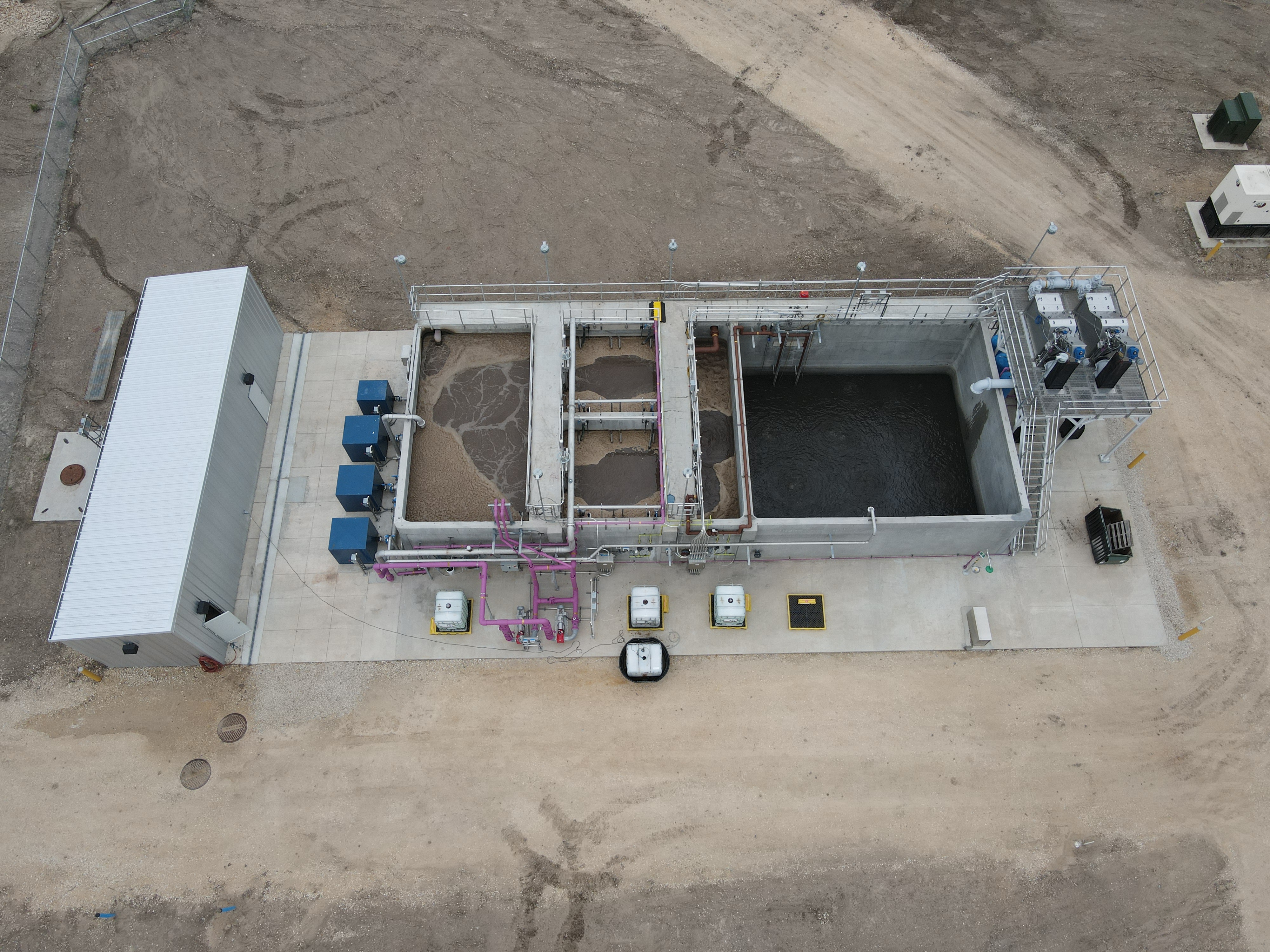
In wastewater treatment, tank shape has traditionally been treated as a structural decision. Round tanks dominate the landscape for a reason, as they are efficient under pressure, familiar to engineers, and proven across decades of use in clarifiers and storage applications.
But treatment systems are changing. As membrane bioreactors (MBRs) replace settling processes and decentralized facilities take on a larger role, the question is no longer just how to build a tank; rather, it is how to build a treatment vessel that aligns with the process inside it.
In that context, geometry starts to matter in a different way.
The Shift from Structure to Process
Conventional wastewater design centered around gravity separation. Clarifiers required circular geometry to support rotational flow patterns and solids settling behavior. The structure and the process were tightly linked.
MBR systems break that relationship.
Solids separation is no longer driven by gravity. It is controlled by membranes that are typically arranged in flat sheet stacks or hollow fiber bundles. These systems operate in defined zones, with air scouring, permeate collection, and mixed liquor circulation all occurring within a structured, modular layout.
Once settling is removed from the equation, the need for circular geometry diminishes. The focus shifts toward how efficiently the treatment process can be arranged within the available volume.
Usable Volume and Internal Efficiency
A round tank may be structurally efficient, but it is not always space-efficient when housing modern treatment equipment.
MBR systems are inherently rectangular in how they are deployed. Membrane cassettes are arranged in rows. Aeration systems are distributed in linear grids. Walkways, piping, and access zones follow straight-line layouts.
When these systems are placed within a circular boundary, inefficiencies emerge. Curved walls create peripheral areas that are difficult to utilize effectively. Equipment layouts must adapt to the structure rather than the other way around, which can lead to uneven spacing, constrained access, and underutilized volume.
A straight-wall, square tank eliminates those constraints. The entire interior footprint becomes usable. Membrane arrays can be installed wall-to-wall. Aeration and mixing systems can be distributed evenly. Maintenance access can be planned consistently across the basin.
The result is a higher density of treatment capacity within the same footprint.
More Capacity in Less Space
This becomes particularly important at smaller scales.
In decentralized applications, like satellite plants, private utility systems, and new developments, sites are often constrained. Available land may be limited. Setbacks, topography, and adjacent infrastructure all shape what can be built.
At these scales, every square foot of footprint carries cost implications.
Square, straight-wall structures allow treatment systems to be packed more efficiently into these constrained sites. More gallons per day can be delivered within a smaller area, reducing excavation, civil scope, and overall site complexity.
This is not simply a design preference. It directly affects capital deployment. When more capacity can be achieved within a tighter footprint, projects that would otherwise require larger sites or more extensive civil work become viable.
Aligning Structure with MBR Systems
MBR systems benefit from consistency. Membrane performance depends on uniform aeration, stable hydraulics, and predictable operating conditions. These are easier to achieve when the physical environment supports a repeatable layout.
Straight-wall tanks provide that consistency.
Membrane racks can be installed in standardized configurations. Air distribution systems can be aligned with membrane zones. Flow patterns can be controlled more precisely without the disruptions introduced by curved boundaries.
Maintenance considerations also improve. Flat sheet membranes, in particular, benefit from accessible layouts that allow for inspection, cleaning, and replacement without navigating irregular geometry. Even hollow fiber systems, which offer high packing density, perform best when installed within structured, predictable arrays.
The goal is not simply to fit membranes into a tank. It is to create an environment where the system can operate as designed, without compromise.
Geometry and Decentralized Economics
The impact of geometry extends beyond process performance into project economics.
Smaller facilities in the 1 to 1.5 MGD range are becoming more common as utilities and developers shift toward decentralized strategies. These systems must compete on cost per gallon constructed, even at smaller scales.
Square tank geometry supports that shift by improving footprint efficiency and reducing unnecessary civil work. More treatment capacity can be delivered within a given site, and expansion can be planned in modular increments without redesigning the entire facility.
This aligns with a broader change in capital strategy. Instead of building large, centralized plants sized for long-term projections, owners can deploy capacity in phases, closer to the point of demand.
In that model, efficiency at smaller scales is a foundational design choice.
Where Round Still Fits
None of this suggests that round tanks are obsolete. They remain well-suited for applications where structural efficiency and pressure distribution are the primary drivers, particularly in large-scale storage or traditional clarification processes.
But in MBR systems, where separation is no longer dependent on settling, the advantages of circular geometry are less relevant. The design problem has shifted.
The question has turned into one about how to maximize treatment performance, capacity, and operability within a given footprint.
Designing for the System, Not the Shape
The broader takeaway is straightforward. Wastewater infrastructure is evolving, and the physical form of treatment systems should evolve with it.
Square, straight-wall structures are not inherently better because of their shape. They are better suited to modern MBR systems because they align with how those systems are designed, installed, and operated.
When structure and process are developed together, rather than independently, facilities become more efficient, more scalable, and more predictable over time.
In a market defined by constrained sites, phased growth, and increasing performance expectations, that alignment is not a minor detail. It is a design requirement.